


EtO Sterilization in Veterinary Hospitals: Risks, Regulations & the Plasma Alternative
This blog post discusses the new laws and regulations around EtO Sterilization in Veterinary Hospitals. Below is a summary of the risks, regulations, and a quick touch on the plasma sterilization alternative.
Key Takeaways
- EtO is a known human carcinogen. Ethylene oxide is classified as a known human carcinogen by the U.S. EPA and linked to leukemia, lymphoma, and breast cancer.
- Many veterinary hospitals use EtO daily. In specialty, referral, and 24-hour practices, EtO sterilization is a core operational dependency — not an occasional backup.
- Regulation is complex and evolving. The federal NESHAP rule is currently being reconsidered, but California’s Airborne Toxic Control Measure and OSHA exposure standards remain in force, and state-level oversight continues to expand.
- EtO creates real facility constraints. External venting, segregated HVAC, and 12–24 hour aeration cycles limit facility design, landlord approval, and surgical throughput.
- Plasma sterilization offers a modern alternative. Hydrogen peroxide plasma sterilization processes the same heat-sensitive instruments in 17–25 minutes, requires no venting, and leaves no toxic residuals.
Introduction
Low-temperature sterilization is essential to modern veterinary medicine. As surgical procedures grow more advanced and instruments more complex, veterinary hospitals increasingly depend on sterilization methods that can safely process heat- and moisture-sensitive equipment. For decades, ethylene oxide (EtO) gas sterilization filled that need, becoming a routine part of in-hospital operations — especially in specialty, referral, and 24-hour facilities.
But the context around EtO has shifted significantly. Ethylene oxide is a well-established human carcinogen, and regulatory scrutiny has intensified at both the federal and state level over the past decade. At the same time, plasma-based low-temperature sterilization technologies have matured into proven alternatives that deliver the benefits of EtO without its long cycle times, toxic residuals, or facility constraints.
This article explains where EtO sterilization stands today for veterinary hospitals, what regulators are doing, and how plasma sterilization compares as a practical replacement.
How Often Is EtO Used in Veterinary Hospitals?
Unlike centralized commercial sterilization facilities, veterinary hospitals that operate EtO systems often run them daily, and in some cases multiple times per day. This is especially true in:
- 24-hour emergency and specialty hospitals
- Referral centers performing orthopedics, neurology, or advanced soft-tissue surgery
- Large-animal or mixed practices that process long or complex lumened instruments
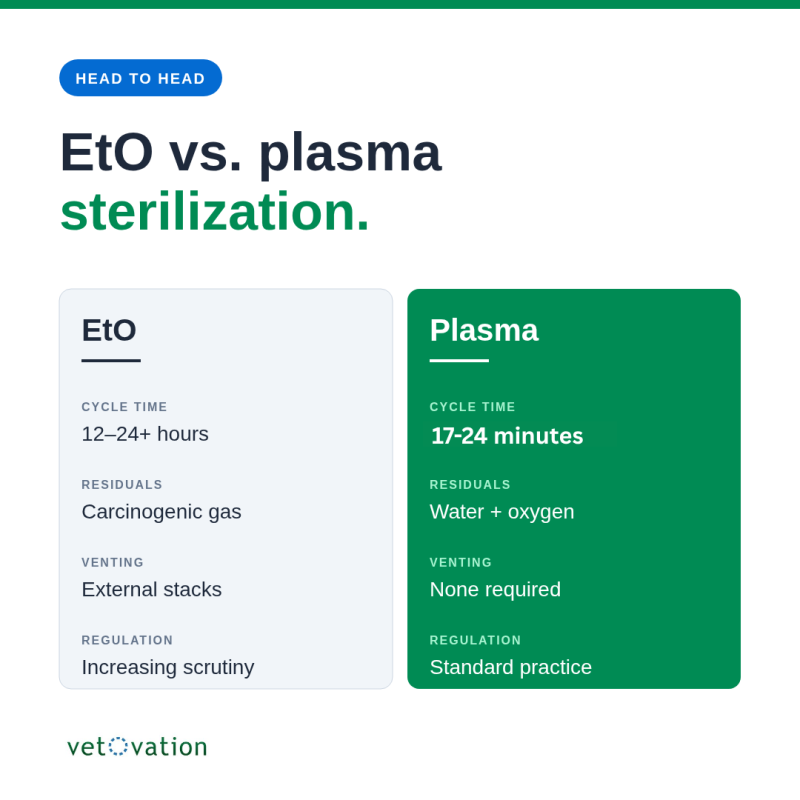
In these settings, EtO is not a backup, it is a core operational dependency that enables continuous surgical throughput. Because EtO cycles must be followed by extended aeration, instrument turnaround times frequently exceed 12 to 24 hours. This forces hospitals to invest in duplicate instrument sets and plan well in advance to support their surgical schedules.
Is Ethylene Oxide Safe for Veterinary Use?
Ethylene oxide is classified by the U.S. Environmental Protection Agency (EPA) as a known human carcinogen. Long-term exposure has been linked to:
- Lymphocytic leukemia
- Non-Hodgkin lymphoma
- Breast cancer
- Reproductive harm
According to the Agency for Toxic Substances and Disease Registry, other health effects can include lung irritation, headaches, memory loss, numbness, nausea, and vomiting. EtO is also mutagenic, meaning it can damage DNA directly.
Although veterinary professionals do not handle EtO at industrial volumes, repeated daily use in enclosed healthcare environments raises legitimate occupational and environmental safety concerns. Unlike steam, EtO is a gas that requires careful containment, aeration, and exhaust management to prevent accumulation and unintended exposure.
OSHA’s permissible exposure limit for EtO is 1 part per million (ppm) as an 8-hour time-weighted average, with a short-term exposure limit of 5 ppm over 15 minutes (29 CFR 1910.1047). Hospitals using EtO must implement engineering controls, exposure monitoring, and a written compliance program to meet these requirements.
Federal regulation: 2024 NESHAP rule under reconsideration
The regulatory picture for EtO is currently in flux at the federal level, but state-level and occupational safety requirements remain firmly in place.
In March 2024, the EPA finalized major amendments to the National Emission Standards for Hazardous Air Pollutants (NESHAP) for Ethylene Oxide Commercial Sterilizers (40 CFR Part 63, Subpart O), citing updated cancer-risk modeling and improved understanding of low-level exposure. The rule significantly tightened emissions requirements for the roughly 90 commercial sterilization facilities nationwide.
In March 2025, the EPA announced it was reconsidering the 2024 final rule, and in March 2026, the agency formally proposed to repeal portions of the standards, citing medical supply chain concerns. The public comment period closed May 1, 2026, and the final outcome remains pending.
For veterinary hospitals, this means the federal regulatory direction is uncertain, but the underlying science on EtO health risks has not changed. State and local regulators continue to act independently of federal rulemaking.
State regulation: California and beyond
California’s Airborne Toxic Control Measure (Title 17 CCR §93108) explicitly regulates non-commercial sterilizers, including in-hospital EtO units, imposing strict requirements on ventilation, aeration, and emissions monitoring. The South Coast Air Quality Management District’s Rule 1405 adds further requirements for facilities in the Los Angeles region.
Other states with active or proposed EtO oversight include Illinois, Michigan, Connecticut, Maine, New York, New Jersey, Georgia, Texas, and North Carolina. The specifics vary by jurisdiction, but the direction is consistent: EtO use in healthcare settings is becoming more closely regulated, more expensive to operate, and more administratively complex.
Occupational safety: OSHA standards apply everywhere
Independent of EPA action, the OSHA Ethylene Oxide Standard (29 CFR 1910.1047) applies to every healthcare facility that uses EtO, regardless of state. The standard requires exposure monitoring, engineering controls, respiratory protection programs, medical surveillance, and training. None of these obligations are affected by changes to the federal NESHAP rule.
Operational and Facility Constraints Created by EtO
Beyond regulation, EtO creates significant practical challenges for veterinary hospitals.
Mandatory external venting
EtO exhaust must be vented outside the building. This requires:
- Dedicated exhaust stacks
- Segregated HVAC systems
- Negative-pressure aeration spaces
- Ongoing monitoring in some jurisdictions
These are permanent infrastructure commitments, not temporary workflow issues. Once installed, they are expensive to modify or relocate.
Real estate and expansion limitations
Many veterinary hospitals report difficulty:
- Leasing space in retail or mixed-use centers
- Gaining landlord approval for hazardous air exhaust
- Expanding or relocating facilities with EtO infrastructure already in place
In some markets, landlords and developers prohibit EtO venting outright, regardless of regulatory permissibility. This materially limits site selection, growth, and consolidation strategy for veterinary groups. Mobile veterinary surgeons, which is a rapidly expanding segment of veterinary medicine, must sterilize their sensitive equipment in their homes or pay for a separate location. Since EtO cycles are typically run overnight, they are risking exposure to themselves, their families and their pets.
Cost and complexity
EtO systems require chemical handling protocols, staff training, exposure controls, compliance documentation, and longer instrument downtime with redundant inventory. As regulatory expectations evolve, these operational burdens compound.
What Is Plasma Sterilization?
Hydrogen peroxide plasma sterilization, also known as vaporized hydrogen peroxide (VHP) plasma sterilization, is a low-temperature sterilization technology widely used throughout modern human and veterinary healthcare. It operates at approximately 50–55°C, making it suitable for the same heat- and moisture-sensitive instruments traditionally processed with EtO.
Plasma sterilization achieves microbial inactivation by introducing hydrogen peroxide vapor into a sealed chamber, then exciting it into a plasma state using radio-frequency energy. At the end of the cycle, the hydrogen peroxide breaks down into water vapor and oxygen, leaving no carcinogenic or toxic residues on instruments or in the chamber.
Advantages of plasma sterilization for veterinary hospitals
- Rapid cycles: typical cycle times range from 17–24 minutes, enabling same-day instrument reuse
- No external venting: no exhaust stacks or aeration rooms required
- No carcinogenic residuals: eliminates EtO exposure risk for staff and patients
- Proven sterility: achieves sterility assurance levels (SAL) of 10⁻⁶, the standard for healthcare sterilization
- Facility flexibility: compatible with retail, mixed-use, and constrained footprints
- Reduced inventory burden: eliminates the need for duplicate instrument sets driven by EtO turnaround times
For veterinary hospitals performing continuous surgery, plasma sterilization supports both patient safety and operational efficiency without the regulatory and infrastructure burden of EtO.
EtO vs. Plasma Sterilization: Side-by-Side Comparison
What Can Be Sterilized With Plasma?
Plasma sterilization is compatible with a broad range of heat- and moisture-sensitive medical and veterinary instruments commonly used in modern surgical practice. Compatible items include:
- Electrocautery instruments
- Endoscopic tools
- Laser handpieces
- Vessel sealers
- Various types of medical tubing
- Skin staplers
- Endotracheal tubes
- Cameras and scopes
- Laparoscopic equipment
- Orthopedic equipment
These devices tolerate hydrogen peroxide vapor and the plasma phase without degradation, making them well suited for routine low-temperature sterilization.
What cannot be sterilized with plasma?
Only four categories of materials are incompatible with plasma sterilization:
- Cellulose-based materials (paper, cotton, wood, linen)
- Liquids
- Oils
- Powders
These substances either absorb hydrogen peroxide or interfere with the plasma reaction, preventing effective sterilization.
Frequently Asked Questions
Is ethylene oxide safe to use in a veterinary hospital?
EtO is classified by the EPA as a known human carcinogen and is regulated under OSHA’s Ethylene Oxide Standard (29 CFR 1910.1047). Veterinary hospitals can use EtO safely when they implement engineering controls, exposure monitoring, aeration protocols, and a written compliance program. However, the cumulative health, regulatory, and operational burden has led many practices to evaluate alternatives like plasma sterilization.
How long does a plasma sterilization cycle take?
Hydrogen peroxide plasma sterilization cycles typically run 17 to 75 minutes, depending on the load and the specific instrument types. This compares to 12–24+ hours for EtO when aeration is included, which is why many hospitals can move to same-day instrument reuse after switching.
Can I sterilize endoscopes with plasma sterilization?
Yes. Endoscopic instruments, including rigid endoscopes and many flexible scopes, are among the most common items processed with hydrogen peroxide plasma sterilization. Check the specific instrument manufacturer’s reprocessing instructions to confirm compatibility with your specific sterilizer model.
Why are states regulating EtO sterilizers?
States regulate EtO because it is a known human carcinogen with well-documented community and occupational exposure risks. California’s Airborne Toxic Control Measure (Title 17 CCR §93108) explicitly covers non-commercial sterilizers, including in-hospital units. Other states have adopted similar frameworks, and the regulatory trajectory has generally been toward more rigorous oversight, not less.
Do I need to vent a plasma sterilizer?
No. Hydrogen peroxide plasma sterilizers do not require external venting because the cycle byproducts are water vapor and oxygen. This is one of the most significant operational and facility advantages over EtO, which requires dedicated exhaust stacks and segregated HVAC.
What’s the difference between VHP and plasma sterilization?
The terms are often used interchangeably. Vaporized hydrogen peroxide (VHP) sterilization uses hydrogen peroxide vapor alone. Hydrogen peroxide plasma sterilization adds a plasma phase (radio-frequency excitation of the vapor) to enhance microbial inactivation and accelerate breakdown of the peroxide into water and oxygen. Most modern systems marketed for healthcare use the plasma-enhanced approach.
Is the 2024 EPA EtO rule still in effect?
The 2024 NESHAP rule for commercial sterilizers was finalized in March 2024. In March 2025, EPA announced it was reconsidering the rule, and in March 2026 the agency proposed to repeal portions of it. The public comment period closed May 1, 2026, and a final decision is pending. State-level regulations and OSHA exposure standards remain in effect regardless of federal action.
A Practical Path Forward
At VetOvation, we work with veterinary hospitals that depend on reliable, low-temperature sterilization every day — not in theory, but in real clinical workflows. The federal regulatory picture for EtO may shift, but the underlying issues do not: a known human carcinogen with state-level regulatory exposure, OSHA compliance obligations, daily handling risks, and significant facility constraints.
Transitioning to plasma sterilization is not just a compliance decision. It is an opportunity to reduce risk for staff and patients, simplify operations, eliminate venting and aeration requirements, and design facilities that support growth rather than limit it.