


Introduction
Every veterinary surgeon knows the frustration: a complex orthopedic case lands on the table, and the implants available don’t quite match the precision the case needs. Human orthopedic surgeons have long benefited from purpose-built solutions for nearly every clinical scenario. Veterinary professionals, by contrast, have historically been forced to improvise.
That gap has closed dramatically over the past decade. Today’s veterinary orthopedic implant market offers purpose-engineered solutions across two major categories: joint-stabilizing plates for procedures like TPLO and patellar luxation correction, and osteosynthesis plates for fracture repair. The breadth of available systems now covers patients from 1 kg toy breeds to 60+ kg giant breeds.
This guide breaks down what modern veterinary surgeons should know about both categories. We use the LeiLOX system — distributed by VetOvation in partnership with German manufacturer Rita Leibinger Medical — as an example throughout, since it spans the full range of techniques and sizes most general orthopedic practices encounter.
Part 1: Joint Stabilization Plates
The majority of orthopedic plate systems in veterinary medicine are designed for joint stabilization — correcting biomechanical dysfunction in the stifle, patella, and surrounding structures. Five core systems cover the vast majority of joint stabilization procedures.
TPLO plates (Tibial Plateau Leveling Osteotomy)
Tibial Plateau Leveling Osteotomy remains the most widely performed procedure for cranial cruciate ligament (CrCL) rupture in dogs. It is widely considered the gold standard for cruciate repair in medium-to-large breeds, with extensive long-term outcome data supporting its use.

VetOvation’s TPLO Plating Systems line includes both stainless steel and titanium variants. The LeiLox Locking TPLO Plates in Stainless Steel offer proven rigidity at a lower price point, while the LeiLox Swing Locking TPLO Plates in Titanium add superior biocompatibility and reduced imaging artifact. For practices stocking a complete TPLO setup, the Titanium LeiLOX TPLO Plating System (2.7mm/3.5mm) bundles plates, screws, and tray for medium to giant breeds.
A key efficiency feature worth noting: the 2.7/3.5 mm plates accept both 2.7 mm and 3.5 mm screws, and the same cross-compatibility exists in the 2.0/2.4 mm range. This reduces inventory cost while preserving surgical flexibility on the table. Precision osteotomy is supported by TPLO Osteotomy Guides available in multiple sizes.
CBLO plates (CORA-Based Leveling Osteotomy)
CBLO is a more recent evolution that combines aspects of TTA and TPLO into a single technique. Like TPLO, CBLO levels the tibial plateau — but the cut is positioned over the bone’s Center of Rotation of Angulation (CORA), further distally on the tibia. Recent peer-reviewed comparisons of TPLO, CBLO, and CCWO outcomes have shaped how surgeons think about technique selection.

- Juvenile patients. Because the CBLO osteotomy is located below the proximal tibial growth plate, it can be safely performed on dogs whose bones are still actively growing.
- Steep tibial plateau angles. For dogs with naturally steep TPAs (often >30°), CBLO geometry allows correction without leaving the bone structurally compromised.
TPLO remains the procedure of choice for the majority of skeletally mature adult dogs, but CBLO is the right tool for juveniles and outlier anatomies. Modern CBLO systems (including LeiLOX) typically share instrumentation with TPLO and CCWO plates, which streamlines stocking for practices that offer multiple techniques.
CCWO plates (Cranial Closing Wedge Osteotomy)
CCWO is a distinct tibial osteotomy technique that uses linear (straight) cuts rather than the radial cuts of TPLO and CBLO. It is particularly useful in two scenarios:

- Juvenile patients, since the procedure is performed outside the growth zone.
- Patients with steep tibial plateau angles, where traditional TPLO geometry may be less optimal.
The LeiLOX CCWO Locking Plate System shares titanium screws and instrumentation with the TPLO and CBLO systems. For practices that offer all three osteotomy techniques, a single instrument set and screw inventory can cover the complete osteotomy lineup. Standard screws include LeiStar Locking Screws in titanium and stainless steel variants across the full size range.
TTA RAPID (Tibial Tuberosity Advancement)
The original TTA technique faced criticism over the years — concerns about implant complications, cage migration, and surgical complexity limited its adoption for some surgeons. TTA RAPID was engineered specifically to address those issues.

For surgeons who stepped away from TTA in earlier years due to the limitations of the original design, TTA RAPID is worth a fresh evaluation.
Patellar luxation plates
Patellar luxation is one of the most frequently encountered orthopedic conditions in dogs and cats. Historically, surgical correction could be technically challenging with inconsistent outcomes.

For complex cases involving both CrCL rupture and concomitant patellar luxation, LeiLOX TPLO Patella Luxation Spacers integrate directly with standard LeiLOX TPLO plates — addressing both conditions in a single surgery rather than a staged approach.

Part 2: Osteosynthesis Plates for Fracture Repair
While joint stabilization systems address biomechanical dysfunction, osteosynthesis plates are purpose-built for fracture repair — restoring structural integrity to broken bones. The breadth of available sizes and configurations is what makes modern fracture plating systems clinically powerful. VetOvation’s Veterinary Orthopedic Fracture Plating Systems span the full small-animal patient range.
Plate sizing: from nano to standard
Modern fracture plating systems span a remarkable size range. Here’s how the LeiLOX fracture systems organize across patient sizes:

The Nano system deserves particular attention. The NANO Fracture Titanium Plating System (1.0mm/1.3mm) offers 24 different plate configurations engineered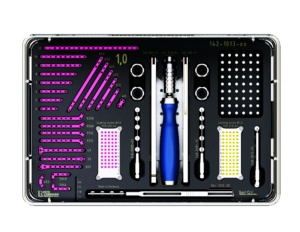 specifically for patients where standard implants are too large. The system includes straight plates, bridge plates, T-plates, L-plates, Y-plates, H-plates, acetabulum plates, and MAYO DFO plates — all in titanium with locking screw technology. This makes precision fracture repair possible in patients as small as 1–2 kg.
The Micro 1.5/2.0 mm System bridges the gap between Nano and Standard, with 32 different plate configurations. 
Cross-compatibility extends here too: the LeiLOX Instrument Set in 2.0/2.4mm shares tools with multiple plate configurations, keeping inventory costs manageable.
Plate types: matching geometry to fracture pattern
Regardless of size, osteosynthesis plates come in several distinct configurations. Each is designed for specific fracture patterns and anatomical locations.
Locking plates (straight). The workhorse of fracture fixation. Locking plates create a fixed-angle construct between screw and plate, providing angular stability independent of plate-bone friction.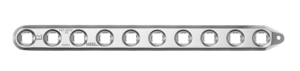 This preserves periosteal blood supply and is particularly valuable in osteoporotic bone or comminuted fractures.
Reconstruction plates. Designed with notches between screw holes that allow contouring in three dimensions. 
Bridge plates. Used in bridging osteosynthesis — spanning a comminuted fracture zone without attempting to reconstruct every fragment. Bridge plates maintain limb length and alignment while allowing indirect (biological) healing.  They are the right choice for highly comminuted fractures where anatomic reduction of every fragment is neither possible nor desirable.
Arthrodesis plates. Purpose-built for joint fusion procedures. Used when a joint is too damaged to salvage — most commonly the carpus, tarsus, or digits. The design provides the rigidity needed to achieve bony fusion across the joint surfaces.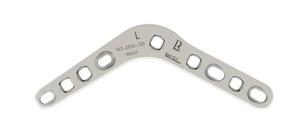 Beyond these core types, modern systems include T-plates, L-plates, Y-plates, Z-plates, H-plates, and acetabulum plates — covering essentially every fracture geometry a small-animal practice is likely to encounter. For specific compression applications, the LeiCOM Cannulated Compression Bone Screws set addresses interfragmentary compression in fractures and arthrodesis.

